

A 200W solar panel represents the sweet spot for many residential and recreational solar applications. Whether you’re powering an RV, setting up a 12V dual-battery system for an Australian touring rig, or looking to start your off-grid power setup, understanding the capabilities and installation requirements of a 200-watt solar panel helps you make informed decisions about energy independence.
This comprehensive guide covers everything from real-world power output calculations to component pairing and installation best practices.
System Quick Reference Table
Before diving into details, here is a quick overview of what you need to run a 200W solar panel system effectively:
| Component | Recommended Specification for 200W System |
| Peak Power Output | 180W – 200W under standard conditions |
| Daily Energy Yield | 800Wh – 1,200Wh (0.8kWh – 1.2kWh) |
| Charge Controller | 20A MPPT Regulator (recommended) |
| Battery Storage | 100Ah – 200Ah Lithium (LiFePO4) or AGM |
| Inverter Rating | 800W – 1,500W Pure Sine Wave |
| Wiring & Fusing | 10 AWG solar cable with a 20A inline fuse |
Compliance Note: Always ensure your off-grid 12V wiring and solar setups adhere to official Clean Energy Council standards for safe battery management and PV installations.
What Is a 200W Solar Panel?
A 200W solar panel is a photovoltaic module designed to produce 200 watts of DC power under Standard Test Conditions (STC)—1,000 watts per square meter of sunlight, a cell temperature of 25°C, and an air mass of 1.5.
In real-world Australian conditions, heat and sun angles vary. On a typical sunny day, a single 200W panel will generally produce between 800 and 1,200 watt-hours (0.8 to 1.2 kWh) of usable daily energy.
Key Physical & Electrical Specifications
-
Physical Dimensions: Approx. 148.5 cm x 68.1 cm x 3.5 cm (58.5″ x 26.8″ x 1.4″)
-
Weight: 11 kg to 15 kg for rigid glass panels (or 2 kg – 3.5 kg for flexible models)
-
Efficiency Rating: 19% to 23.5% using modern monocrystalline cells
-
Voltage Output: Standard 12V systems (Nominal Voltage ~18V–22V Vmp)
-
Cell Technology: High-efficiency Monocrystalline Silicon
How Much Power Does a 200W Solar Panel Produce?
Real-world output depends on weather, geographic location, and seasonal sun hours according to Australian Bureau of Meteorology solar data.
Daily Energy Expectations
-
Best Conditions (5-6 Peak Sun Hours): Up to 1,200 Wh (1.2 kWh) per day.
-
Average Conditions: 800 – 1,000 Wh per day.
-
Overcast / Winter Conditions: 300 – 600 Wh per day.
Key Factors Affecting Output
-
Temperature: Solar panels operate most efficiently at cooler temperatures. In extreme heat (over 35°C), panel efficiency drops slightly.
-
Tilt & Orientation: In Australia (Southern Hemisphere), panels perform best when faced True North at a tilt angle matching your latitude.
-
Shading: Even partial shading across a few cells can drop output significantly.
What Can You Power with a 200W Solar Panel?
A 200W panel combined with a proper battery setup easily powers essential 12V and small AC appliances:
-
12V Fridge / Freezer: Runs a 40L–65L portable upright or chest fridge continuously.
-
LED Lighting & Fans: Powers caravan, tent, or cabin lighting all night.
-
Device Charging: Keeps laptops, phones, camera batteries, and drones charged daily.
-
Small CPAP Machines & Pumps: Supports nocturnal 12V medical devices or small water pumps.
Types of 200W Solar Panels
1. Monocrystalline Rigid Glass Panels
The industry standard. They offer the longest lifespan (25-year performance warranty), highest heat tolerance, and best output value for money.
2. Flexible & Thin-Film Panels
Ideal for curved caravan roofs or marine Biminis where weight is a major concern. (If you are looking for ultra-lightweight mounting on curved surfaces, check out our flexible solar panels guide on flexible solar panels guide for full specs).
3. Folding & Portable Solar Blankets
Great for temporary camping setups. You can park your vehicle in the shade and set up the blanket in direct sun using an extension lead.
Essential Components for a Complete 200W System
To convert solar energy into safe usable power, you need three main components:
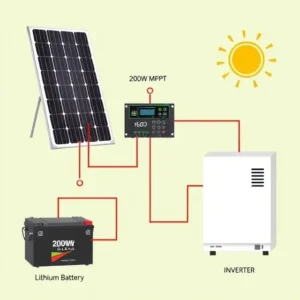
1. Charge Controller (20A MPPT Recommended)
To calculate controller size: 200W / 12V = 16.6 Amps. A 20-Amp MPPT charge controller gives you optimal efficiency and room for solar output spikes.
-
MPPT vs PWM: MPPT controllers are up to 30% more efficient than PWM controllers, especially in variable sunlight or high ambient heat.
2. Battery Storage
-
100Ah Lithium (LiFePO4): Recommended. Provides 80-100Ah of usable power at half the weight of lead-acid.
-
120Ah AGM / Lead-Acid: Budget option, but recommended depth of discharge is 50% (60Ah usable).
3. Inverter (If running 240V AC appliances)
-
A 800W to 1,500W Pure Sine Wave Inverter allows you to charge laptops, run small power tools, or operate a TV safely.
Installation Best Practices
-
Orientation (Southern Hemisphere): Always tilt fixed panels towards True North to maximize daily solar harvest across Australia.
-
Mounting Ventilation: Maintain an air gap of at least 25mm to 50mm beneath rigid panels to allow heat dissipation.
-
Cable Sizing: Use minimum 10 AWG (6mm²) solar cables for short runs between the panel, controller, and battery to minimize voltage drop.
-
Safety Fusing: Place a 20A fuse or circuit breaker between the charge controller and the battery positive terminal.
Frequently Asked Questions (FAQs)
Can a 200W solar panel run a fridge?
Yes. A 200W solar panel paired with a 100Ah battery generates more than enough power to run a typical 12V 40L-65L camping fridge continuously during average weather conditions.
What size battery do I need for a 200W solar panel?
A 100Ah Lithium (LiFePO4) battery or a 120Ah–150Ah AGM battery is the sweet spot for a 200W solar panel system.
How long does a 200W solar panel take to charge a 100Ah battery?
Under good sun conditions (generating roughly 10-12 Amps through an MPPT controller), a 200W panel can charge a 100Ah battery from 50% to full in approximately 4 to 5 hours.
Summary
A 200W solar panel is a versatile and cost-effective power source for caravans, off-grid sheds, marine setups, and backup systems. Pair it with a 20A MPPT regulator and a 100Ah lithium battery for reliable off-grid power.

