

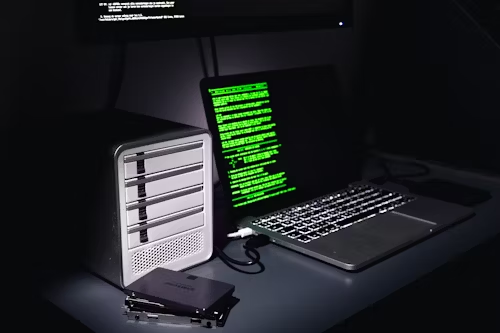
A cybersecurity high school textbook is more than only one book-it is a practical guide to help young learners (age 14–18) helps understand the responsible use of digital safety, online security and technology. Unlike the tutorial scattered on the Internet, these textbooks offer structured texts, real -world examples and hands on hands that make cyber security accessible and exciting.
Why do people discover Cybersecurity High School Textbook?
For Students
Students usually search for cyber security textbooks because they want:
- A clear introduction to core themes such as malware, fishing and moral hacking.
- Making safe passwords such as step-by-step labs, detection of fishing email, or practicing Wi-Fi security.
- A passage to detect career in cyber security, IT and moral hacking.
- Guidance in preparation for competitions such as cyberpatriot, cyberstart, or CTF.
For teachers
Teachers often seek cyber security textbooks:
- Find out the structured text plans formed with the school curriculum.
- Access classroom projects, quiz and discussion signals.
- Change random online resources with a consistent, reliable guide.
- Support STEM programs and digital literacy initiatives.
For deep support in the construction of a cyber security course for high school, teachers can detect Nice Framework Resource Center.
For Parents
Parents can turn to cyber security textbooks when they want:
- Teach your children practical safety skills – achieving scams, managing privacy and navigating social media responsibly.
- Encourage your child’s interest in technology and prepare them for future career.
- Ensure that the material is age-appropriate, beginner-friendly and safe.
Major topics involved in a cybersecurity high school textbook
Most high quality textbooks for adolescents cover the following areas:
- The basic principles of cyber security – essential conditions, risk awareness and safety practices.
- Cyber threatening-virus, phishing, ransomware, social engineering and modern AI-operated attacks.
- Network Safety-Firewall, Encryption, VPN, Wi-Fi security and password security.
- Moral hacking and cyber law-white-hat vs. Black-Hat Understanding, as well as the role of morality and privacy.
- Simple projects such as hands-on labs-firing email detection, safe file handling and infiltration basics.
For students curious about real -world cyber security roles and skill paths, nice workforce framework equipment offers an excellent starting point.
Learning results for students
By working through a cyber security textbook, students can:
- Identify and reduce risks from normal cyber hazards.
- Apply safe browsing and safe communication methods.
- Identify legal and moral responsibilities in digital places.
- Create confidence through laboratories, exercise and challenges of solving problems.
- Start preparing for future certificates, competitions and university level IT courses.
Additional Learning Recommended Resources
With textbooks, students and teachers can expand their knowledge:
- Khan Academy Computer Science-Mufts Early-Original Tutorial (Go here)
- National Cyber League (NCL) – Competitive Sports and Practice Labs (Travel here)
- Cyberpatriot competition-Students challenges on hand (Visit here)
Tips and tricks to use cybersecurity textbooks effectively
- Start with the basics – do not hurry in advanced subjects. First create a strong foundation.
- Do daily practice – spend at least 20-30 minutes, try laboratories and exercises, not just the principle.
- Competitions include-Cabberpatriot or platforms such as NCL helps in learning real-world practice.
- Pair with online resources – use Khan Academy or official outline such as Nice understanding.
- Parents and teachers should be involved – guidance and discussion help students to connect cyber security lessons with everyday life.
- Pay attention to the problem-solution. Encourage the students to think like guards, spotting weak points and fixing them.
With structured texts, hands activities and perfect mentality, a cybersecurity high school textbook exceeds a resource-it becomes a launchpad for safe digital habits and future technology career.
For more on cybersecurity presentations and how to pitch concepts effectively, check out Cybersecurity Pitch Deck to Investor PPTX.

